
Why the Scroll Matters
Jul 23, 2026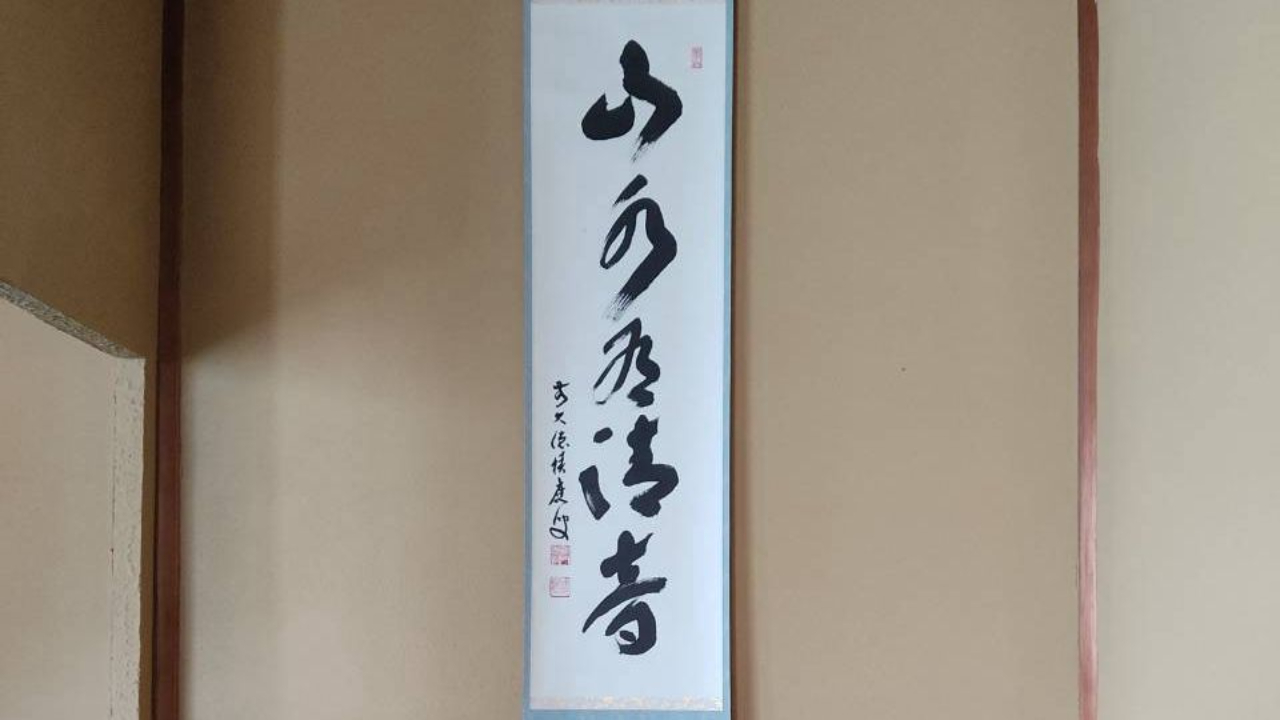
One of the questions I am occasionally asked is why the tea room always contains a hanging scroll.
Many people assume it is simply decoration.
Others notice that the scroll changes with the seasons and conclude that it serves to create an appropriate atmosphere.
Both observations are true.
Yet neither explains why the scroll occupies the most important place in the tea room.
The scroll is not there because it is beautiful.
It is there because tea ceremony is one of the few traditions that continues to preserve human wisdom—not merely as ideas written in books, but as something embodied and lived.
Every scroll bears a few carefully chosen characters.
Sometimes they are only four or five.
Yet behind those few words often lie centuries of human experience.
A Zen master who experienced awakening.
A Buddhist teaching refined over generations.
A Chinese poet reflecting on the nature of life.
A line from classical literature.
A calligrapher who devoted decades to perfecting the movement of the brush.
The paper, the ink, the handwriting, the words themselves, and the person who chose to display them all become part of a single conversation that continues across time.
Tea asks us not merely to read these words.
It asks us to live with them.
This is something I have come to appreciate more deeply over the years.
When I study tea, I rarely study a scroll in isolation.
If I encounter a phrase such as 薫風自南来 (Kunpū Jinanrai), I want to know where those words first appeared. Who wrote them? Under what circumstances? How did later generations understand them? Why did Zen masters choose to preserve them? Why do tea practitioners continue to display them every summer?
The same is true of phrases such as 諸行無常 (Shogyō Mujō) or 清流無間断 (Seiryū Kandan Nashi).
These are not simply beautiful expressions.
They are entrances into entire worlds of thought.
Through a single scroll we encounter Buddhism, Confucianism, Daoism, Chinese poetry, Japanese literature, history, philosophy, and the lived experiences of countless people who came before us.
Without these people, the words would never have existed.
Without the words, many of the ideas themselves might have faded with time.
And without the tea room, many of us might never pause long enough to encounter them.
This, I believe, is one of tea ceremony's quiet gifts.
Tea does not preserve the past as a museum preserves artifacts.
A museum protects objects from change.
Tea asks each generation to receive what has been handed down, to understand it, to embody it, and then to allow it to live again through their own practice.
The scroll is therefore not an object of admiration.
It is an invitation.
An invitation to enter into conversation with those who came before us.
To ask not only what they believed, but why.
To discover what questions they were trying to answer.
And perhaps to recognize that many of those questions remain our own.
How should we live?
How should we meet another person?
What is worth cultivating?
What remains when circumstances change?
The tea room rarely attempts to answer these questions directly.
Instead, it offers a bowl of tea, a few flowers, a kettle quietly boiling, and a single phrase hanging in the alcove.
The conversation begins there.
For me, this is why the scroll remains indispensable.
It reminds us that tea is not simply about preparing tea.
It is about preserving—and continually rediscovering—the wisdom that helps us become more fully human.
Every generation inherits tea ceremony in two ways.
We inherit its forms.
But we also inherit the responsibility to understand the human insights those forms were created to carry.
Only then does the scroll cease to be ink on paper.
It becomes a living teacher.
And perhaps that is why it occupies the place of honor in the tea room.
Shogyō Mujō — Seiryū Kandan Nashi
All Things Are Impermanent — The Clear Stream Flows Without Interruption
Among the scrolls displayed during the summer months, one occasionally encounters the phrase:
清流無間断
Seiryū Kandan Nashi
"The clear stream flows without interruption."
Closely associated with it is another of Buddhism's most familiar expressions:
諸行無常
Shogyō Mujō
"All conditioned things are impermanent."
Today these phrases are often understood simply as reminders that everything changes.
While true, this only hints at the remarkable depth that lies behind them.
To understand these scrolls is to glimpse the intellectual and spiritual landscape from which Japanese tea ceremony emerged.
The World Behind the Scroll
Before the Meiji period, an educated person in Japan was traditionally expected to cultivate themselves through three great streams of thought.
Confucianism offered guidance for living responsibly within society through works such as the Analects.
Daoism, through the writings of Laozi and Zhuangzi, explored the cultivation of the inner life and the natural way of being.
Buddhism asked perhaps the deepest questions of all: What is the nature of reality? Why do human beings suffer? How might we live wisely within a world that is constantly changing?
These traditions did not compete with one another.
Rather, they complemented one another, shaping the intellectual and cultural foundations from which tea ceremony eventually grew.
A Teaching for Everyday Life
During the Kamakura period, Buddhism spread beyond the aristocracy and became part of ordinary life.
Zen found a home among the warrior class.
The teachings of Shinran and Pure Land Buddhism spread among farmers and common people.
Both traditions, despite their different methods, shared a remarkably practical orientation.
Neither sought escape from the world.
Both asked how one might live well within it.
Zen master Dōgen encouraged wholehearted practice through zazen.
Shinran assured even those who believed themselves beyond redemption that liberation was not reserved for the privileged.
Their paths differed, but both addressed the same human condition.
The River That Never Stops Flowing
The Buddha often explained reality through the image of a river.
Nothing remains fixed.
Everything arises through causes and conditions, changes continuously, and eventually passes away.
This understanding became one of Buddhism's central teachings:
諸行無常
Shogyō Mujō.
Nothing conditioned remains exactly as it was.
This insight is not unique to Buddhism.
The Greek philosopher Heraclitus famously observed that one cannot step into the same river twice.
In Christianity, baptism in the River Jordan symbolizes death to an old life and rebirth into a new one.
Pilgrims continue to bathe in the Ganges for similar reasons, marking a transition from one state of life to another.
Across cultures, flowing water has long symbolized continual renewal.
Beyond Comparison
Why does impermanence matter?
Because much of our suffering arises from believing that life should remain as it is—or become what we wish it to be.
Zen therefore speaks of 無分別智 (Mufunbetsuchi), the wisdom that sees without constantly dividing experience into success and failure, gain and loss, fortunate and unfortunate.
It also cautions us through the phrase:
莫妄想 (Maku Mōzō)
"Do not be carried away by delusive thinking."
Do not become trapped in calculations, expectations, or attempts to manipulate life according to your own desires.
Observe reality as it is.
Only then can genuine wisdom appear.
The Clear Stream
This brings us back to the summer scroll.
清流無間断
Seiryū Kandan Nashi.
The clear stream never ceases.
Yet the water flowing before us is never the same water.
Every moment is both continuity and change.
The stream remains.
The water is always new.
The same insight appears in one of the most celebrated passages of Japanese literature. In the opening lines of Hōjōki, Kamo no Chōmei writes:
"The flow of the river is ceaseless, and yet the water is never the same."
For centuries, these words have reminded readers that permanence is an illusion.
Life itself is movement.
The Tea Room
This is why these phrases continue to appear in the alcove of the tea room.
Not to encourage melancholy.
Nor to remind us merely that life is fleeting.
Rather, they invite us to participate fully in the present encounter, knowing that it can never be repeated.
The bowl of tea prepared today will never be prepared in exactly the same way again.
The conversation shared today will never occur again.
The people gathered today will never again be exactly as they are now.
Far from making the moment insignificant, impermanence gives it immeasurable value.
Like the stream, tea continues to flow.
Each gathering is new.
Each encounter is unique.
And perhaps this is why tea ceremony remains a living practice.
It teaches us not to resist change, but to receive it with gratitude.
Give yourself this amazing gift and unlock the door to a wealth of traditional Japanese values and rituals that will allow you to implement a beautiful, relaxing and mindful practice in your life.
Sign up for the Tea Ceremony Online Course today!
Stay connected with news and updates!
Join our mailing list to receive the latest news and updates from our team.
Don't worry, your information will not be shared.
We hate SPAM. We will never sell your information, for any reason.

Author

