
本来無一物 — Originally, There Is Nothing
Sep 27, 2026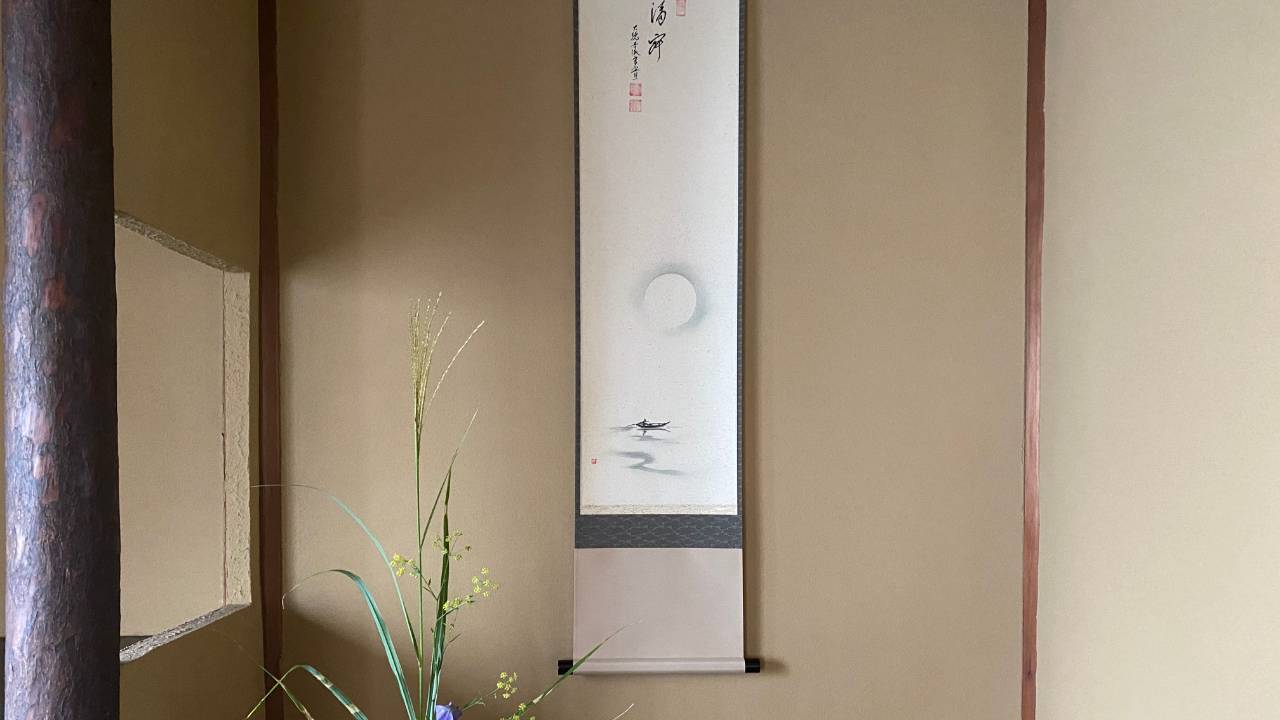
本来無一物 — Originally, There Is Nothing
Honrai Mu Ichimotsu
There is a famous story in the 六祖壇経 — Rokuso Dankyō, the Platform Sutra of the Sixth Patriarch, concerning two verses written on the wall of a Zen monastery.
At the time, the Fifth Patriarch 弘忍 — Kōnin had many disciples, but one monk in particular, 神秀 — Jinshū, was regarded as exceptionally learned and was expected by many to become his successor.
Kōnin asked his disciples to express their understanding of the Dharma in a verse.
Jinshū hesitated.
If he wrote a verse because he genuinely wished to seek the Way, that would be good.
But if he wrote it because he wanted to become the next patriarch, that would be another matter.
Eventually, late at night, he secretly wrote his verse on the monastery wall:
身是菩提樹
心如明鏡台
時時勤拂拭
莫使惹塵埃
“The body is the Bodhi tree,
the mind is like a clear mirror.
Constantly polish and wipe it,
and do not allow dust to settle.”
The meaning is clear.
Human beings possess an originally pure mind, but our lives become covered by greed, anger, attachment, distraction and confusion. Just as a mirror becomes obscured by dust, the mind must continually be polished through practice.
It is a beautiful teaching.
And yet, according to the story, it is not yet the deepest realization.
Among the monks at the monastery was a young man named 盧 — Ro, later known as 慧能 — Enō, the Sixth Patriarch.
He had been born into poverty and had received almost no education. He could not read or write.
He worked in the rice-pounding room of the monastery.
One day, before becoming a monk, he had been walking through town selling firewood when he heard someone reciting the Diamond Sutra — 金剛経.
One sentence stopped him:
応無所住而生其心
“Let the mind arise without abiding anywhere.”
Something in those words moved him deeply.
He eventually entered Kōnin's monastery, where he continued working in the rice-pounding room.
He had been there for months without ever entering the main hall.
When he heard Jinshū's verse being recited, he asked someone to read it to him.
After hearing the verse, Enō said:
“I, too, have a verse.”
The monks were surprised.
A poor, illiterate worker was going to compose a verse on the Dharma?
Someone wrote his words on the wall:
菩提本無樹
明鏡亦非台
本來無一物
何處惹塵埃
“Originally, there is no Bodhi tree.
The clear mirror is not a platform.
Originally, there is nothing at all.
Where could dust possibly settle?”
The difference between the two verses is subtle, but profound.
Jinshū speaks of practice:
There is a mirror.
It becomes covered with dust.
Therefore, we must continually polish it.
Enō points to something prior to that:
Where is the mirror?
Where is the dust?
What is it that we imagine needs polishing?
His verse does not reject practice.
Rather, it points beyond the idea that practice is an activity performed by one fixed self upon another fixed object called “the mind.”
This is why the story returns to the words that had first awakened Enō:
応無所住而生其心
Let the mind arise without abiding anywhere.
Do not become attached even to the idea of having a pure mind.
Do not become attached to the idea of removing an impure mind.
Do not become attached to the distinction between pure and impure.
Simply meet what is present without allowing the mind to become fixed there.
This is 無所住 — mushojū: not abiding anywhere.
And it is also why the story is so striking when we remember who Enō was.
He was not the most educated monk.
He was not the most accomplished scholar.
He was not the person everyone expected to inherit the Dharma.
He was the man in the rice-pounding room.
The story deliberately overturns our assumptions about where wisdom is supposed to reside.
We often imagine that understanding comes from accumulating more knowledge, refining ourselves, correcting our weaknesses and becoming a better version of who we already are.
There is great value in such cultivation.
But Zen asks another question:
What remains when there is nothing left to improve?
The answer is not another concept.
It is not something to possess.
It is something to encounter directly.
This distinction is important in tea as well.
Tea practice asks us to refine ourselves.
We learn how to handle the utensils.
We learn how to prepare tea.
We learn how to move.
We learn how to observe.
We learn how to receive another person.
We polish our movements again and again.
At first, this can feel like Jinshū's mirror:
practice, correct, polish, refine.
And this is necessary.
But there may come a point when the practice asks something deeper.
Can we stop trying to manufacture the “correct” self?
Can we act without becoming trapped by the thought of acting correctly?
Can attention respond naturally to what is actually happening?
Can the hand move without the mind standing apart and directing every movement?
This is where 応無所住而生其心 becomes particularly meaningful.
The mind does not need to become empty before we can act.
Rather, when we do not cling to any fixed position, the appropriate response can arise naturally.
A guest arrives.
The tea is prepared.
The room is quiet.
Something unexpected happens.
And we respond.
Not from a rehearsed idea of what a tea master should be.
Not from anxiety about whether we are performing correctly.
Not from attachment to our own image.
Simply from what this moment asks of us.
But the story does not end with Enō's verse.
Kōnin recognized the depth of what the young rice-pounder had understood. He also understood something else.
The other monks would not necessarily receive this recognition with the same clarity.
Enō was an unknown, poorly educated worker who had suddenly demonstrated an understanding that surpassed the learning of those who had spent years studying the Dharma.
The danger was not merely that the monks might disagree with him.
Envy and ambition could turn their resentment into something much more serious.
Kōnin therefore called Enō and told him:
「何としても、
今すぐ、ここを発ちなさい。」
“Whatever happens,
leave this place immediately.”
The words are striking.
The teacher who has recognized realization must now protect the person who has realized it.
Kōnin gave Enō the robe and bowl and instructed him to leave.
Enō escaped from the monastery and made his way toward the river.
Kōnin followed and eventually helped him cross the water in a small boat, carrying him away from the danger that had arisen among his fellow monks.
The scene is easy to imagine:
the monastery behind him,
the river beneath him,
a small boat moving across the water,
and the moon illuminating the journey.
Years later, this episode would be remembered through another enigmatic Zen phrase:
東山水上行
Tōzan Suijō iku
“The Eastern Mountain walks upon the water.”
At first, the words seem impossible.
A mountain cannot walk upon a river.
Yet the phrase points directly back to Enō's escape.
The monastery where the story took place was associated with the Eastern Mountain — 東山, Tōzan.
But 東山 can also be understood as referring to Enō himself.
The Eastern Mountain is no longer fixed in one place.
It moves across the water.
The one who was thought to be the lowest among the monks has become the mountain itself, moving freely beyond the boundaries that had been placed around him.
There is also something quietly beautiful in the image.
The mountain does not literally move.
The river does not literally carry a mountain.
Yet in the moonlit scene, the impossible becomes possible.
The Eastern Mountain moves upon the water.
The phrase points beyond ordinary distinctions of movement and stillness, high and low, teacher and student, learned and unlearned.
And it carries another meaning within the story.
Enō is leaving behind the narrowness of those who could not see beyond position, status and rivalry.
He does not defeat them through argument.
He simply leaves.
The one who has nothing to defend can continue on his way.
This is why 東山水上行 has become such a meaningful phrase in the world of tea.
Written on a scroll, accompanied by an image of a small boat crossing a river beneath the full moon, it does not merely depict a beautiful landscape.
It carries the entire story within it.
A mountain that moves.
A river that carries what should be immovable.
A person leaving behind what he no longer needs to remain within.
And a moon illuminating the way without asking anything in return.
The image also brings us back to 本来無一物 — Honrai Mu Ichimotsu.
Originally, there is nothing to possess.
There is no fixed mirror.
No fixed dust.
No fixed self.
And when we do not cling to such fixed positions, movement becomes possible.
The story of Enō therefore does not simply tell us that one verse was deeper than another.
It asks us to look at what happens when understanding becomes real.
Real understanding changes how we stand in the world.
It changes how we respond to danger.
How we leave.
How we cross.
How we meet what comes next.
In tea, we begin by polishing the mirror.
We learn the forms, refine the movements, study the utensils, observe the seasons and learn how to care for another person.
But eventually, practice may bring us to the place where there is no longer a mirror to polish.
There is only the moment before us.
And we must cross the river.
Perhaps this is why a small boat beneath a full moon can say so much.
東山水上行。
The Eastern Mountain walks upon the water.
And the mountain moves.
Give yourself this amazing gift and unlock the door to a wealth of traditional Japanese values and rituals that will allow you to implement a beautiful, relaxing and mindful practice in your life.
Sign up for the Tea Ceremony Online Course today!
Stay connected with news and updates!
Join our mailing list to receive the latest news and updates from our team.
Don't worry, your information will not be shared.
We hate SPAM. We will never sell your information, for any reason.

Author

